

After years of feeling unheard by city and state agencies regarding high voltage transmission cables being laid under the Norwalk River as part of the Walk Bridge project, the Norwalk Harbor Management Commission will have its 15 minutes in the spotlight.
The CT Department of Energy and Environmental Protection (DEEP) has scheduled a public hearing, public site visit and pre-site-visit information session concerning the Transmission Relocation portion of the Walk Bridge project. Representatives from DEEP, Eversource and Norwalk City officials will be available to answers questions from the public.
Meeting schedule:
- May 15 – Pre-hearing conference, 11:00 a.m. via Zoom. Registration required. (no public comments)
- May 22 – Public site visit, 10:30 a.m. at Norwalk River Boat Ramp, Veterans Park (no public comments or questions)
- May 29 – Public hearing, 6:30 p.m. via Zoom. Registration required.
- June 5 – Deadline for submitting written comments.
- June 6 – Evidentiary hearing, 9 a.m. via Zoom. Registration required.
Official schedule available at the CT DEEP Calendar of Events.
“We requested a hearing with DEEP, circulated a petition among residents and within hours had enough signatures” to satisfy DEEP, said Alan Kibbe, Chair of the NHMC.
“The purpose of the hearing is to put into the public record and document that the NHMC is looking to support the public interest, and that has to do with the future impact on the city’s ability to repair maintain and replace the visitors dock and the boat launching ramp,” Coastal Area Planning Consultant Geoff Steadman said at the NHMC’s meeting April 24.
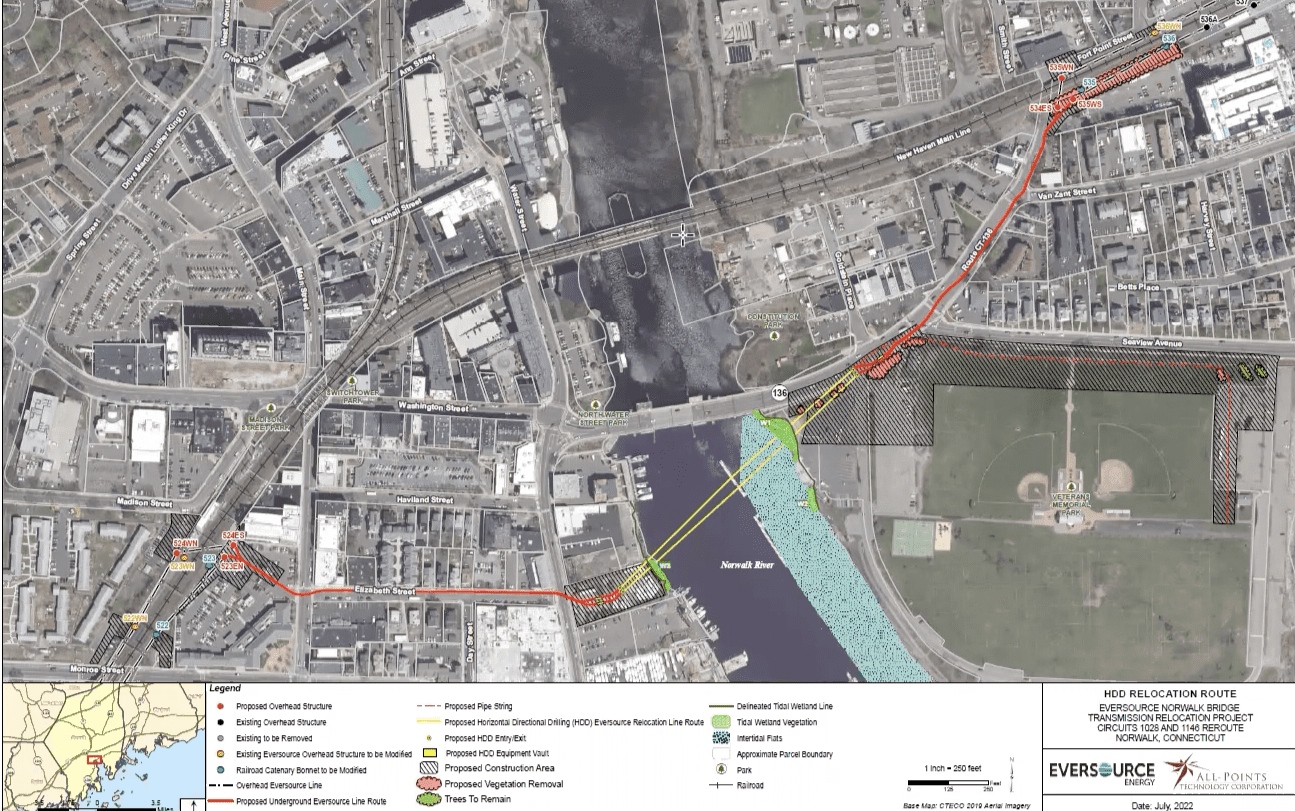
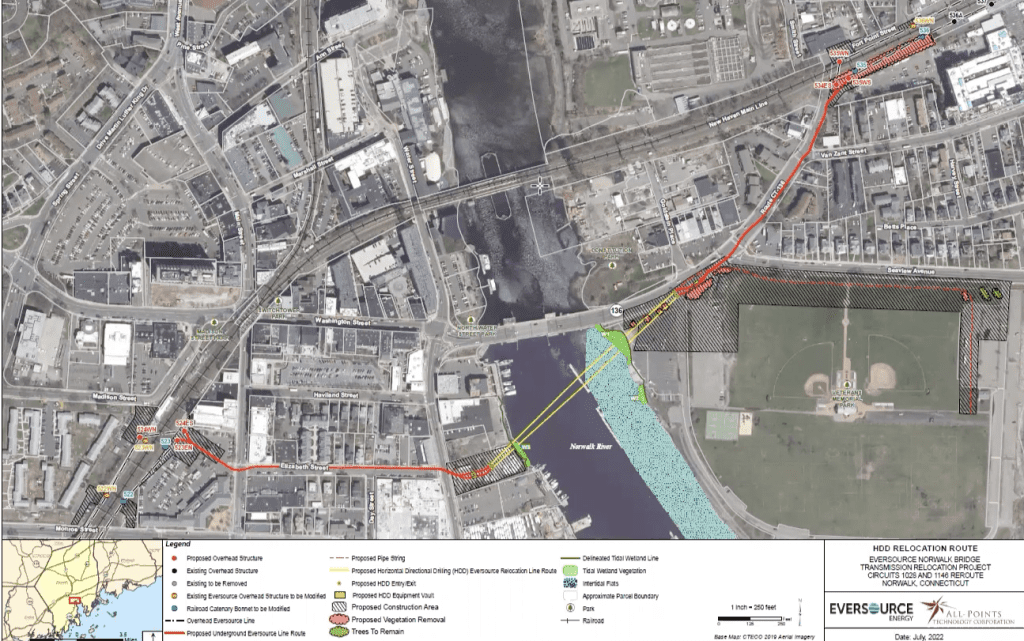
For years, the NHMC has felt ignored, despite its objections several times about this portion of the Walk Bridge project, which involves removing the two existing 115-kV electrical transmission lines and burying them under the Norwalk River.
NHMC has repeatedly objected to the location of the lines, which run underneath the launch ramps and dock at Veteran’s Park, making it difficult and potentially dangerous to do any repairs or expansion to the public launch area.
Digging technology has gotten better in the last decade
While the DOT started out using a drilling technique called “High Directional Drilling,” (HDD), for bridge-related cables, it recently switched to a more modern drilling technology called micro-tunneling. Micro-tunneling involves placing the cable in 60” concrete tunnels that are accessible for repairs and updates to the wires inside.
NHMC wants to know why Eversource isn’t considering the same.
“The City of Norwalk should be asking if it is possible that these cables could be micro-tunneled the entire .75 miles from East Norwalk, under Vet’s Park, the Norwalk River, Elizabeth Street, and Main Street to the Norwalk Police Department without excavation. That would be amazingly less disruptive to Norwalk,” the NHMC’s hearing application reads.
The hearing application continues, “CTDOT’s recent decision to abandon horizontal drilling in favor of micro-tunneling under the river for relocation of the Walk Bridge’s high-voltage and signaling cables prompts the question, is this also a better way to install Eversource’s cables where they will be out of harm’s way as well as being easily replaceable, serviceable, inspectable, and upgradeable for the foreseeable future?”
Who pays if it breaks?
And then there is the issue of who bears the cost of fixing the cable in an emergency — after a storm. for example.
Commissioner Matt Gifford pointed out that, as a public entity, the state will have to fix all bridge-related issues. “But if there’s something from the Eversource side, who’s going to own [the cost] at this point, what’s going to be involved, is it going to be a city issue or not? And it’s going to be dumped on the city’s lap and we’re going to be left holding the bag.”
What’s needed, says NHMC, is assurance – in writing – that Eversource will cover the costs of any future work that might come from these cables.
Steadman added that “DEEP has in its draft permit a condition requiring Eversource to post the 700 -plus thousand-dollar bond to cover any inadvertent spills from drilling fluid. The [Army] Corps of Engineers will have a condition that if this affects the maintenance of the harbor [channel], which it won’t, Eversource moves the cable. Why would anybody think it’s illogical that there should be a condition that if the city has an added expense, Eversource pays for it?”
Promises of protection?
In October 2018 the Common Council approved the project, with the contingency that Eversource provide an affidavit with such assurances to the city. “There was to be a statement,” said Steadman, “attesting that the city’s interests would be protected in the future use of the dock.”
Eversource did, in fact, produce an affidavit, but critics say it was more protective of the utility than the city.
Has the train left the station?
Although several commissioners expressed doubt at getting Eversource to change plans at this point, Kibbe said, “we should not give up on getting it right.”
When asked what NHMC hoped to accomplish in these meetings, Kibbe replied:
“The goal is to prevent Eversource from controlling future development on the Norwalk River. The current Eversource plan puts their HV transmission cables beneath the launch ramps and between dock pilings of our public docking facility.
“Regardless of whatever Eversource may say now, there will be exclusion zones above and around those cables once they are operational. Any modification or new development in this vicinity will require Eversource approval and assistance IF they choose to give it. The cost would be extraordinary! Norwalk cannot not give up future control of one of its most important economic growth areas.”


Leave a Reply
You must Register or Login to post a comment.