

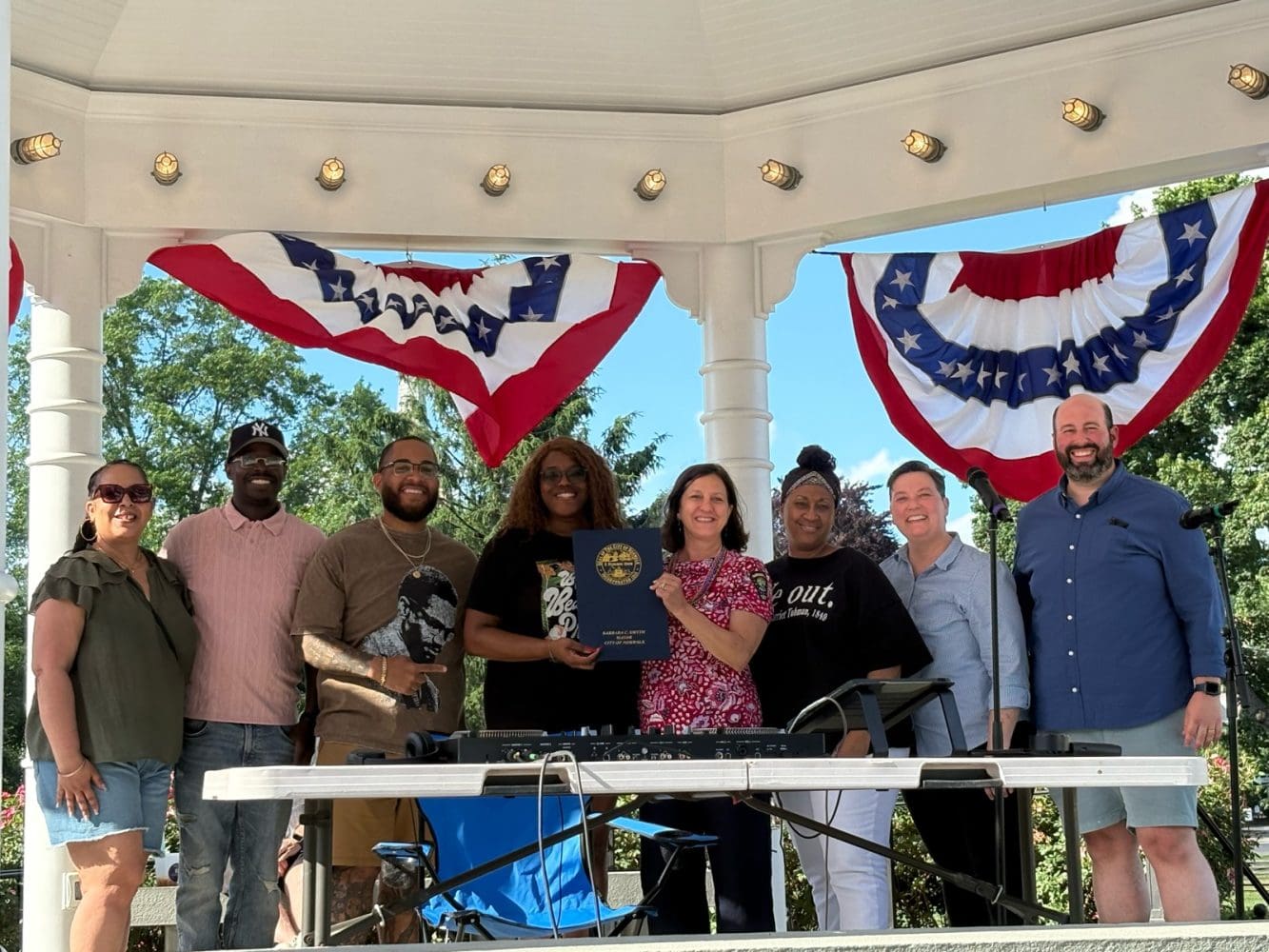
NORWALK, Conn. — Norwalk residents poured into the Norwalk Green Saturday for the First Taxing District’s fifth annual celebration of Juneteenth, a day marking when enslaved people in Galveston, Texas, learned of their emancipation on June 19, 1865.
Despite President Abraham Lincoln issuing the Emancipation Proclamation in 1863, it was initially largely unenforceable in states that seceded. Union soldiers reached Galveston to enforce emancipation for the remaining enslaved people months after Confederate General Robert E. Lee officially surrendered in 1865.
Romney Donald, an organizer with Black Voice for Empowerment and Progress that helped run Saturday’s event, said people — whether curious or looking to “stir up some trouble” — consistently ask why an event that happened in Texas should be celebrated in Norwalk.
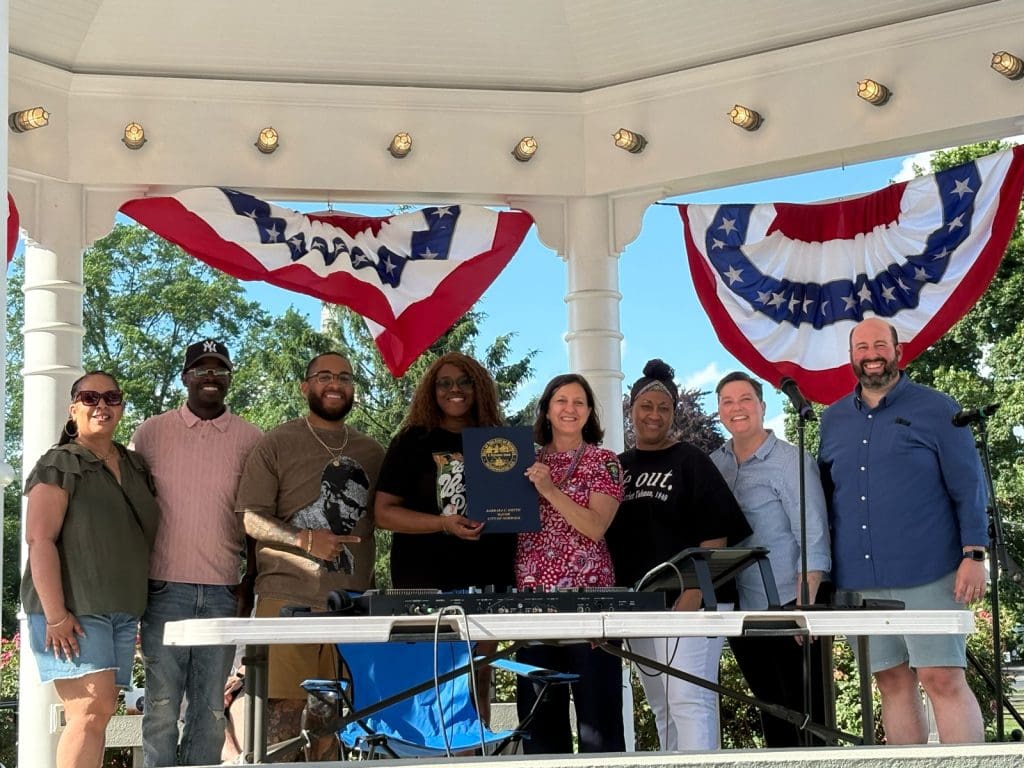
(Photo by Kyle Chouinard)
Donald said she usually responds by noting that Independence Day is celebrated throughout the country, even though the Declaration of Independence was signed in Philadelphia. The same goes for celebrating Memorial Day “in places where no battle was fought,” she said.
“It’s not just Black history, it’s American history,” Donald said, adding later that “we can celebrate these events because they are part of our national history, and Juneteenth deserves that same understanding.”
That understanding from the general public is a relatively recent development, with many Juneteenth celebrations, including Norwalk’s, gaining renewed attention following nationwide protests in 2020 after the killing of George Floyd.
Juneteenth became a federal holiday in 2021 before Connecticut officially recognized it as a state holiday in 2022.
Donald said that Juneteenth was also missing from her early education, which started and ended with Martin Luther King Jr., Harriet Tubman, and Malcolm X. It wasn’t until she went to college that she learned what Juneteenth was.
Donald doesn’t want the same for Norwalk’s students. This year, the event partnered with Norwalk Public Schools and had performances with students from Jefferson Elementary.
“Juneteenth represents the triumph of human spirit over the darkest chapters of American history,” Norwalk Mayor Barbara Smyth said during the event. “As a former educator, I believe we must always remember our history to understand our present.”
Na’Zya Fearon and Akafia Haye — two youth leaders with the nonprofit House of Darla — not only explained the history of Juneteenth to the crowd, but also abolition’s place in Connecticut’s past.
Just three years after the United States declared independence, two men enslaved in Fairfield County — Prime and Prince — petitioned the Connecticut General Assembly for their freedom, Haye explained.
They were denied, and slavery wouldn’t be officially abolished in the state until 1848, Fearon added.
Fearon and Haye also addressed the meaning of the Juneteenth flag, which has a red and blue field with a white star surrounded by a burst in the center. The star, Fearon explained, represents the freedom of Black Americans across the country.
The flag’s designer, Ben Haith, also returned home to Norwalk last week to raise his now-iconic design.
“As young leaders, we believe it is our responsibility to learn this history, share these stories, and continue the work of building a more just and inclusive community,” the pair said in unison. “May we honor their legacy not only with our words today but through our actions every day.”
The United States’ colonial history has been on display this year as the country prepares to celebrate its 250th anniversary next month. In Washington, D.C., the festivities have already started, with the White House hosting UFC fights on its South Lawn last Sunday.
Donald said that Juneteenth gives her an opportunity to “reflect honestly” on the country’s history. For many Black Americans, she said, “the conversation about freedom and independence can be really layered and complex, because our ancestors were still enslaved.”
“Juneteenth does allow us to acknowledge the truth, while also celebrating the countless contributions that Black Americans have made to building and strengthening this nation,” she said.
Correction: A previous version of this article stated that the Emancipation Proclamation only applied to states in the Union. This is inaccurate. While the Emancipation Proclamation did not immediately free slaves in Confederate states, President Abraham Lincoln’s order did apply to them.



Leave a Reply
You must Register or Login to post a comment.