

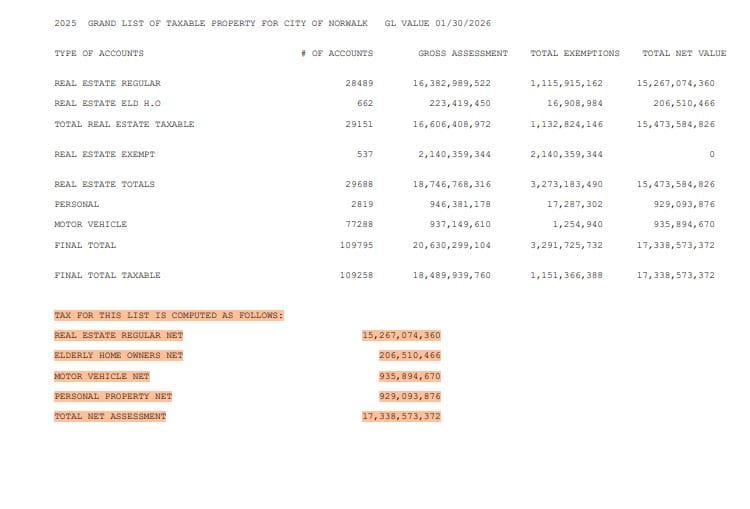
NORWALK, Conn. — Norwalk’s total taxable property value reached a record $17.34 billion in 2025. A review of street-level records shows that a significant share of that value is located along several major corridors.
The city uses this total value, known as the Grand List, to determine how much property tax revenue it can collect to pay for schools, police, fire, and other services.
Of the $17.34 billion total:
- Real estate makes up $15.47 billion
- Motor vehicles account for $935.9 million
- Business equipment and other taxable property total $929.1 million
While that figure reflects property value citywide, a review of 20 Norwalk streets shows much of that value is clustered along a few major corridors.
Wide variation by street
NancyOnNorwalk reviewed and assessed values for 20 randomly selected roads, representing a mix of residential, commercial, and mixed-use corridors across multiple neighborhoods.
Total property value per street ranges from under $10 million on smaller residential roads to nearly $490 million along major corridors such as Main Avenue. Connecticut Avenue and Westport Avenue also rank among the highest.
A small number of major roads account for hundreds of millions of dollars in taxable value, while many residential streets represent a much smaller share.
Value per mile
To better compare streets of different lengths, NancyOnNorwalk also calculated the per-mile value for five roads.
A half-mile segment of West Avenue has an assessed value of approximately $403.8 million, or about $807.6 million per mile.
By comparison, a 0.9-mile segment of Cranbury Road has an assessed value of approximately $20.9 million, or about $23.3 million per mile.
Other streets fall between those extremes depending on the type of development. Washington Street and Aiken Road generate more value per mile than most streets made up primarily of single-family homes.
Roton Avenue stands out among residential roads. While it is mostly single-family homes, higher home prices push its value per mile above many other residential streets.
Value concentrated on West Avenue
West Avenue shows how a small number of buildings can account for a large percentage of a street’s total value.
Four large apartment complexes — Piper Apartments, The Waypointe Apartments, 500 West Ave., and Scribe Apartments — together account for about $300 million in taxable value.
That represents roughly three-quarters of the $403.8 million total on the analyzed half-mile segment.
All remaining properties combined total about $86.5 million.
National research on development patterns
Henry Walker of Urban3, a firm that analyzes municipal fiscal productivity, said cities nationwide often see similar patterns.
Urban3 compares how much tax value different types of development produce on a given amount of land.
Walker said compact, walkable areas with a mix of housing and businesses often generate more tax value per acre than spread-out development.
He said that does not necessarily mean skyscrapers. Traditional downtown storefronts, apartment buildings, and older neighborhoods with smaller multi-family homes often generate higher tax values than more spread-out areas.
Norwalk has not conducted a public study comparing tax values by mile or by neighborhood.
How the analysis was done
The street-level analysis is based on the city’s 2025 Grand List parcel dataset.
The file provided by the city contained duplicate parcel entries. NancyOnNorwalk reviewed the dataset and removed exact duplicate rows before calculating totals.
For each property, the analysis used the city’s listed assessed value — the number used to calculate tax bills.
In Connecticut, assessed value is generally 70% of a property’s estimated market value. Street totals were calculated by adding the assessed values of all properties with addresses on each selected street segment, including tax-exempt buildings such as schools, churches, and government buildings.
The analysis does not account for separate tax agreements or abatements that may lower what some property owners actually pay.
NancyOnNorwalk has filed a Freedom of Information request seeking details on active tax agreements and their financial impact. That information was not available at the time of publication.


Leave a Reply
You must Register or Login to post a comment.