


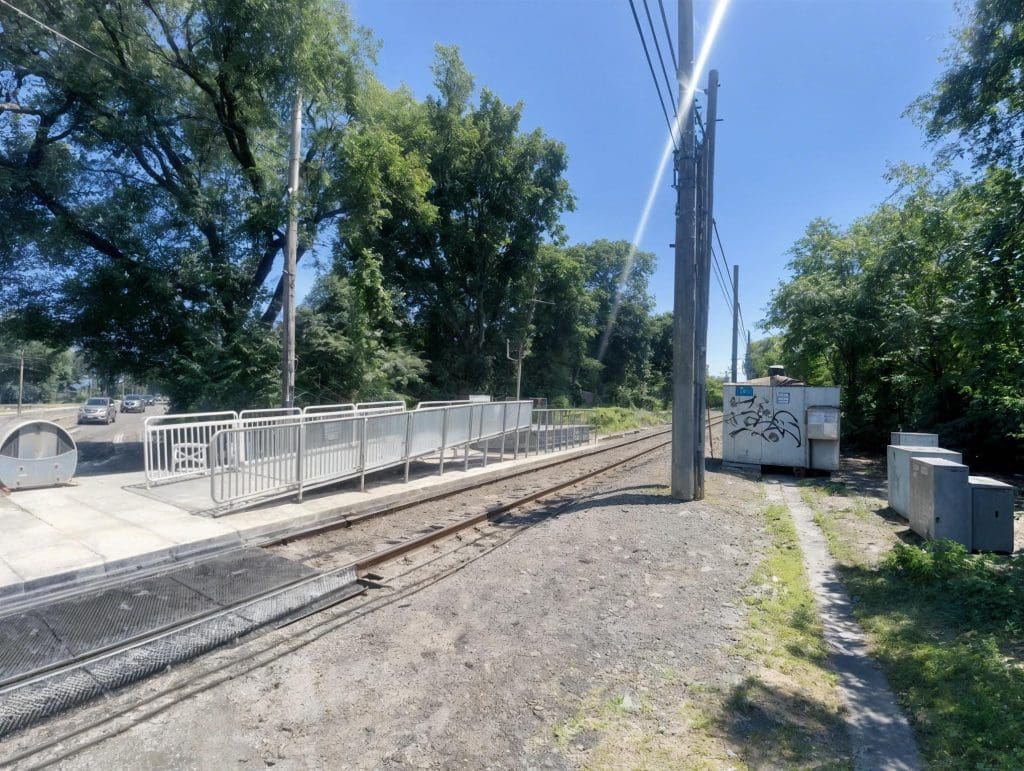
Do you wish Norwalk had more traffic or less? If your answer is the latter, we’re already in agreement: we need the River Line. Devised by volunteers at Sustainable Streets Norwalk, the River Line will ease congestion, invite prosperity, and improve public and environmental health for our city-on-the-sound and Wilton, too. But what is the River Line? What are its aims, what are the costs, and how would Norwalkers benefit?
Along the Norwalk River, Metro-North operates a branch of its railroad services. Terminating in Danbury, the railroad is severely underutilized. Operating almost exclusively to shuttle unfortunate souls commuting into and out of New York, its frequency is laughable, and its stations are inaccessible to pedestrians. But these issues do not indicate redundancy, in fact the opposite is true.
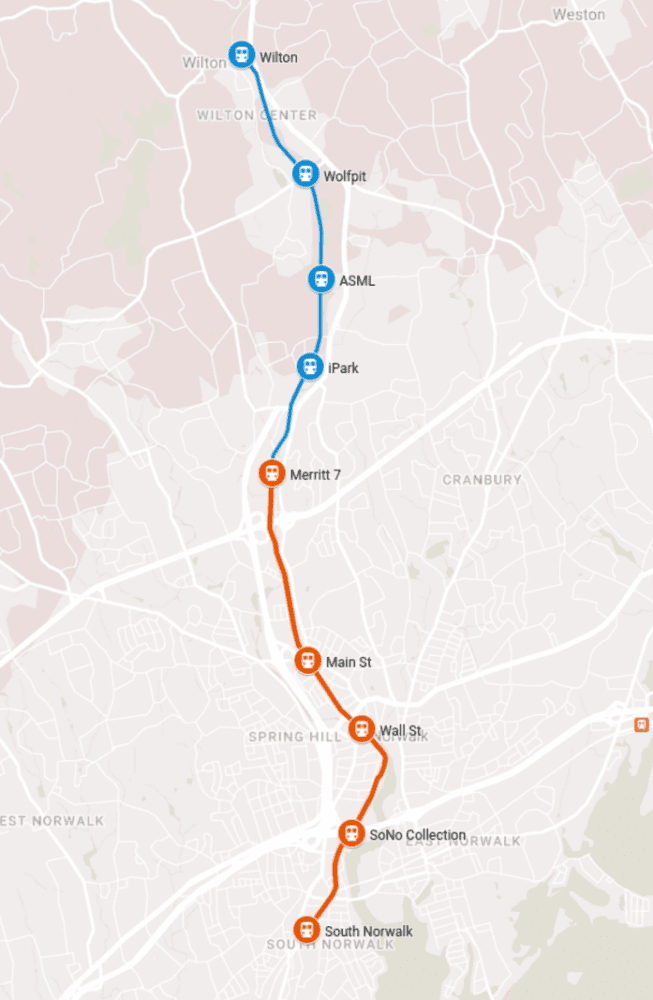
The tracks run past several destinations in the area that suffer from severe traffic congestion. Drivers, trapped in their cars, watch helplessly as trains glide serenely past their destinations. At the SoNo Collection, shoppers come from around the state to stimulate our economy and enrich our treasury. Regional job creators, like technology titan ASML, cite inaccessibility for employees as an impediment to staff retention. Increasing multimodal access through this commercial corridor is essential to our continued economic vitality, and we can do so by opening up these tracks to local service.
This is where the River Line comes in. Along the railroad tracks of the Danbury Branch, new stations can be erected to service local stops, for example at the ASML Campus, Norwalk’s Wall Street, and the SoNo Collection. Local riders could step out directly at their destination, cutting commutes and easing headaches, while also expanding accessibility for seniors, teenagers, and the disabled.
Readers may assume that these grand plans are just idle daydreaming. The challenges facing such a project must be substantial, insurmountable. “If it sounds too good to be true, it probably is.” But what if I told you it was far cheaper and easier than you supposed? What if for 1/100th of the cost of the Route 7/15 interchange, we could have trains zipping up and down the River Line in two years?
The Danbury line is currently supported by one single-track railway. While it would be challenging to run two services (The extant Danbury Line service and the new River Line) on this one track, it would not be impossible, nor prohibitively expensive. The construction of a passing siding near the Norwalk/Wilton border would allow Metro-North and River Line trains to operate every 20-30 minutes in both directions. CTDOT has already studied this and estimated the cost at around $10M.
But what about the rolling stock? The Danbury Line is currently serviced by heavy, diesel-powered locomotives; not ideal for small-scale, localized service. But technological development begets novel solutions: new battery-electric trains can accelerate quickly and have a track record of functionality in Germany. What’s more, modern start-up culture offers an affordable option for local communities seeking rail expansion. Pop-Up Metro LLC, a railroad
development corporation, provides quick-build modular platforms and rolling stock on a lease-basis. This would mean low upfront capital costs, were Norwalk to want the River Line up-and-running quickly.
While Pop-Up Metro offers speed and economy, other options remain. Metro-North could step in with their current rolling stock; battery-pack modifications to their existing commuter rail cars are astonishingly feasible. The regional rail behemoth could also electrify the entire length of the existing line, but this was deemed too expensive in 2016. While many options exist, the best means of activating the River Line is the simplest and cheapest: lease rolling stock and modular platforms from Pop-Up Metro and get trains rolling before the class of 2027 graduates.
Some may argue that the River Line is unnecessary. Why implement a new rail service when Norwalk already offers bus service to the area? Firstly, trains are faster than buses, and are not subject to traffic backups. Train cars are more comfortable, quieter and safer than buses. But most importantly, the construction of rail indicates to job creators and housing developers that the service is permanent. With connections to current and upcoming residential development, the installation of the River Line would help accommodate the explosive demand for housing without overtaxing existing road infrastructure.
Mayor Rilling has expressed support for making Norwalk the “Greenest City in Connecticut,” and we have made great progress! Our expansion of sidewalks and bike infrastructure, as well as Norwalk Transit District’s route reorganization, is proof. The River Line is a chance for Norwalk to spend a little to get a lot: more jobs, cleaner air, and less traffic. Throwing up a local-service train system in just a few years may seem fanciful. But as you have read, it is not only affordable and achievable but, given the opportunities it offers, indispensable.
Editor’s Note:This piece was mistakenly published under my name due to a WordPress autofill. The author is Matt Silber. I apologize for the mix-up. I was in shock from the passing of Council Member Greg Burnett. Thank you for your understanding.


Leave a Reply
You must Register or Login to post a comment.